May 2009
New Homes: The Historical Picture
The current over supply situation became undeniable when our market
exceeded the historical record for specs in January 2006, and it has continued
in that mode for about three years.
We appear to be rapidly moving into a new home shortage mode. This
article provides you with a historical perspective of the new home market so
that you can view the current market in the big picture.
Seven-Year Subdivision Count
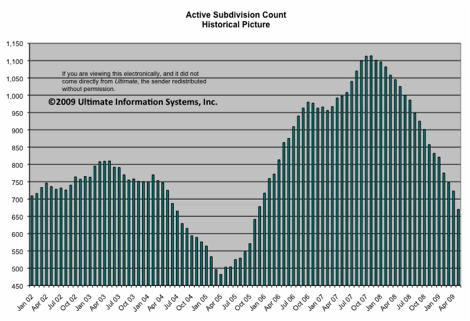
The first two years of the seven-year graph below shows a normal ebb and
flow of active subs; the count climbs in late spring, when builders are
preparing for the summer when sales are typically higher, and declines a little
in late summer. In 2004 and 2005
the active sub count dropped dramatically with the investor/speculator boom,
when new subdivisions could not be brought on-line as fast as active
subdivisions were selling out. The
lowest count was 482 active subs in May 2005.
The sharp increase in the number of subdivisions from June 2005 through
September 2006 can be attributed to builders ramping up to fill the inventory
gap created in the months prior and then overshooting the mark because of
significant changes in demand.
After a few months or relative stability, demand fell off further, and
the count climbed again. Since the
end of 2007 the subdivision count has been declining on a regular basis.
UIS defines an active subdivision
as one accepting contracts from qualified buyers. The subdivision count data we report comes from the Ultimate
New Homes (UNH) database, which covers the entire Phoenix metro market
area and approximates the area covered by the Arizona Regional Multiple Listing
Service (ARMLS). Ultimate New Homes covers all of Maricopa
County (74% of UNH subs) and significant portions of Pinal County (23%
of UNH subs) as well as a few location outside of these counties
(primarily in Yavapai County) (3% of UNH subs).
Six-Year Spec Count
The Ultimate Information
System (UIS) spec count is made up of the individual properties that each
subdivision chooses to report to be included in the UIS system for ARMLS
affiliates. The degree of completeness varies from builder to builder and
from one subdivision to another.
We believe our current count is on the conservative side, as some
subdivisions do not report their total spec quantity to us.
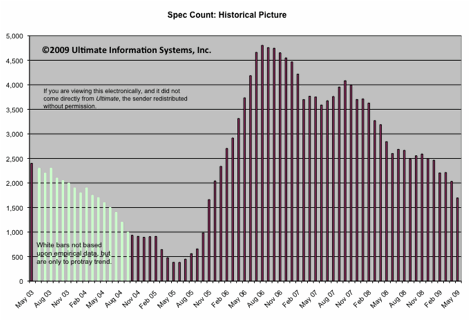
We have compiled comprehensive spec data only back through October
2004. Prior to that our data is
more spotty, but we know that the highest historical spec count was 2,400 in
May 2003. Even with this partial
data, a pattern is readily apparent.
The spec count maintained a normal level throughout 2004, and fell
sharply in 2005 during the speculation boom when supply was unable to keep up
with demand. For a year after
August 2005 the spec count climbed rapidly and then remained at an extremely
elevated level for 18 months. In
the last year the spec count has fallen by about 30% and is continuing to fall.
We will likely face a spec shortage within the next three to four months.
Five-Year Builder Count
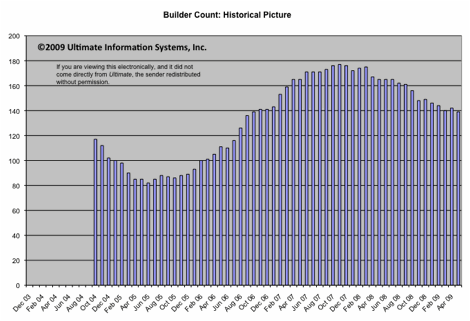
UIS has not compiled complete five-year builder data, but a pattern is
still clearly visible. The highest
historical builder count was in March 2003 - 159 builders. The builder count showed a slow decline
bottoming out in the big boom, as small builders sold out their limited number
of subdivisions and were then no longer actively selling. The builder count started rising again
in June 2005 reaching a peak of over 175 in November 2007. Since then, the count has fallen off,
primarily driven by builders going out of business and putting their
communities on hold.
Copyright® 2009 - This
information is compiled and written by Ultimate Information
Systems, Inc. Use of this article, in part or in its entirety, is
expressly prohibited without written permission. Click here to
request limited rights to reuse this information.